
The Pattern We Keep Forgetting

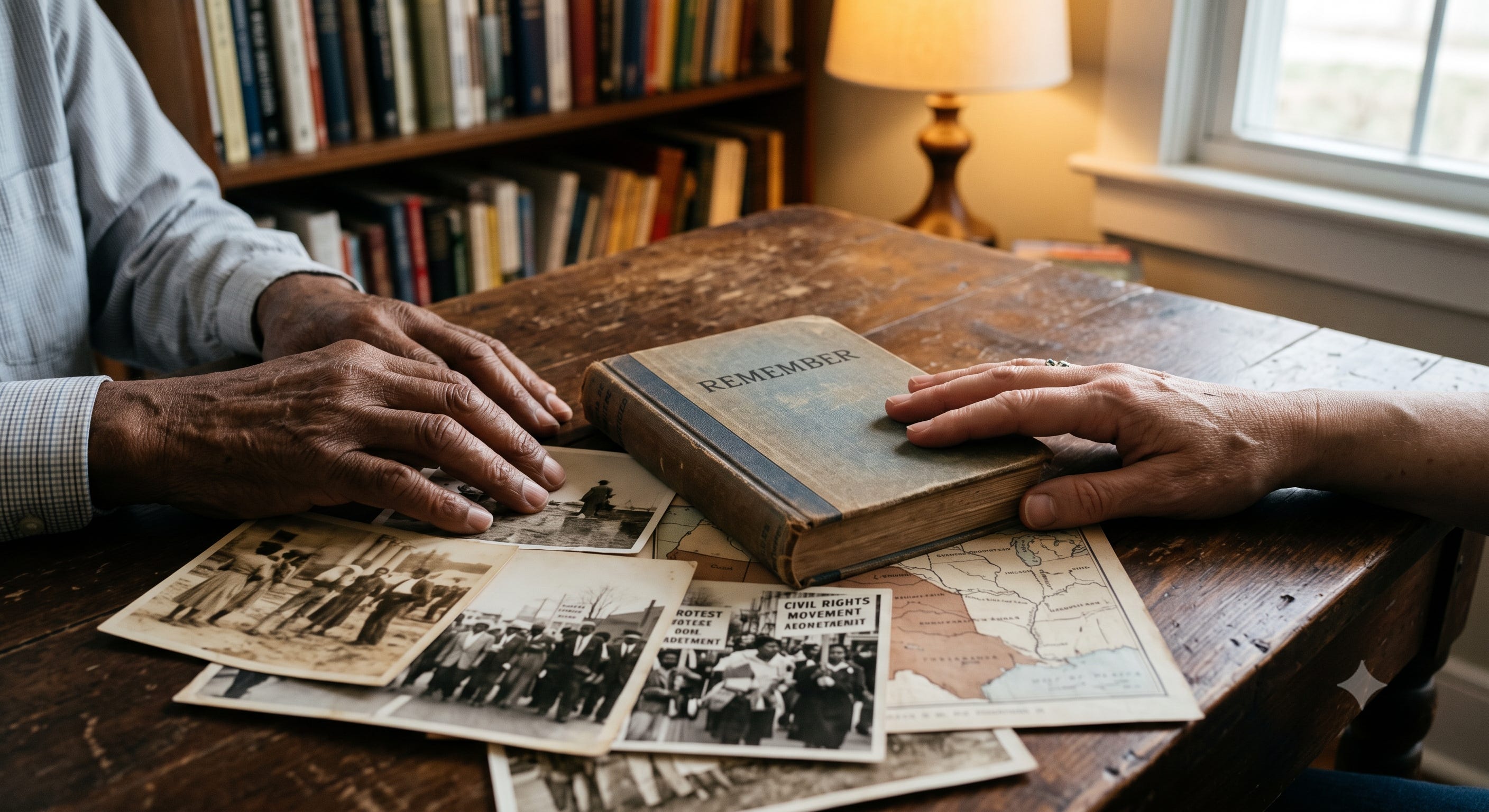
Over the last few months, in conversation after conversation, I keep hearing some version of the same thing: This isn’t normal. This isn’t how our country is. And frankly, I’m kinda tired of it.
I understand what people mean. The attacks on democratic institutions, voting rights, immigrants, LGBTQ people, public education, and the rule of law feel shocking. They should. A healthy democracy shouldn’t function this way.
But if “normal” means unprecedented, I think we’re making a dangerous mistake.
We’ve seen this before. Again. And again.
Jews have a word for what happens when we forget our past: we become vulnerable.
The book of Deuteronomy is Moses’ final sermon before the Israelites enter the Promised Land. Moses spends his last days teaching memory, not predicting the future.
He says: Remember slavery. Remember the wilderness. Remember who you are.
In Judaism, memory is a moral practice. We remember because memory teaches us to recognize the present. Forgetting leaves us vulnerable to repeating the same mistakes.
Black communities in this country also understand that memory is important. Black people have a way of seeing the reality of this country honestly. It is an awareness born from generations of people who learned, often through painful experience, how institutions respond when Black people assert their full humanity. That memory lives in family stories, Black bodies, resilience, and lived experience. It is its own discipline of clear sight, a refusal to let comfortable myths obscure what’s actually happening. Black consciousness tells uncomfortable truths about whiteness and American history.
Judaism says, Remember. Black folks say, Pay attention. Too often, America says, Forget.
When I look at America today, I see America returning to familiar rhythms.
Our national story has never been a straight line toward justice. It’s been a cycle: people organize, democracy expands, those who benefit from the old order organize a backlash. The language changes. The targets change. The laws change. The pattern stays remarkably consistent.
After the Civil War, Reconstruction promised a multiracial democracy. Black Americans voted, held office, built schools and businesses, imagined a future once unthinkable. Then came the backlash: lynchings, coups, Jim Crow, the destruction of thriving Black communities, new laws built to preserve an old hierarchy.
The Civil Rights Movement challenged that hierarchy again — Brown v. Board of Education, the Civil Rights Act, the Voting Rights Act, fair housing. Then came another backlash: political realignment, mass incarceration, attacks on voting rights, economic disinvestment, new appeals to “law and order” that mostly preserved existing power.
The roots of this pattern reach back to the displacement and murder of Indigenous peoples. That history has its own forced forgetting — broken treaties, erased place names, whole nations written out of the story America tells about itself. The creation of racial slavery drew on the same logic: decide who counts as fully human, then build the laws and the silence to protect that decision. Democracy expands, and new systems emerge to decide who fully belongs.
I don’t see race as one issue among many. Whether we’re talking about labor organizing, immigration, women’s equality, LGBTQ equality, or religious freedom, race is woven through the story. American political power has repeatedly organized around the idea of whiteness — and I’m not talking about skin color alone — but a social and political identity determining who could belong, who could own property, whose voice counted. Its boundaries have shifted; Irish, Italian, and Jewish immigrants from Europe were gradually incorporated into its privileges. Indigenous nations were never offered that path — their claim to this land was something to be erased from the record entirely. But the underlying pattern holds: democracy expands, and someone tries to redraw the boundaries of belonging.
We see the same pattern today. Immigration is framed as invasion rather than belonging. LGBTQ people are cast as threats rather than neighbors. Voting rights are narrowed in the name of election integrity. Books are removed in the name of protecting children. The language changes. The mechanism does not. Each moment asks the same question: Who belongs fully within the American story?
What we’re witnessing isn’t simply a backlash against particular communities. It’s a backlash against remembering.
Against remembering slavery. Against remembering Reconstruction. Against remembering whose land this was before it became the United States. Against remembering that democracy has always required ordinary people to organize, resist, and widen the circle of belonging.
If backlash is part of the American story, so is resistance. Every movement toward justice has faced organized opposition. Every generation has been told expanding democracy has gone too far. Every generation has had to decide whether to retreat or continue the work.
Judaism calls us to something deeper than optimism. It calls us to covenant.
A covenant is a commitment to one another, even when the path is uncertain. Covenant asks us to keep showing up, keep remembering, keep pursuing justice, because faithfulness demands it, whatever the outcome.
The Torah commands us to pursue justice, again and again, as an ongoing act rather than a final achievement. History doesn’t bend on its own. People bend it. Covenant is the decision to keep pulling, even when the arc seems to be moving in the wrong direction.
So I’m less interested in having a conversation about whether this moment is normal. I’m more interested in asking whether we recognize it.
Because if we recognize the pattern, we remember something else: backlash has never been the end of the story. People organized before us. People resisted before us. People expanded the meaning of democracy before us.
Memory is how we recognize the moment we’re in.
We’ve been here before.
Which means we also know what comes next.
Ordinary people organize.
They remember.
They refuse to surrender the promise of a more expansive democracy.
Now it’s our turn.
Please listen to my friend Eric Kilburn’s song all the way through to the end. Let me know what you think. Also Eric is going to produce my next album, more of that to come later.
Brilliant! "Judaism says, Remember. Black folks say, Pay attention. Too often, America says, Forget." This is the best line I've read online in years:
A great overview of this topic. We have been unable to confront the sins of our past as is a nation. Christian nationalists are whitewashing history and gaslighting people to not believe their own reality. Turning Point USA sends “educators” into schools to indoctrinate children to be Hitler Youth and parents are doing a lousy job of countering this malicious behavior. We are certainly on a knifes edge.